
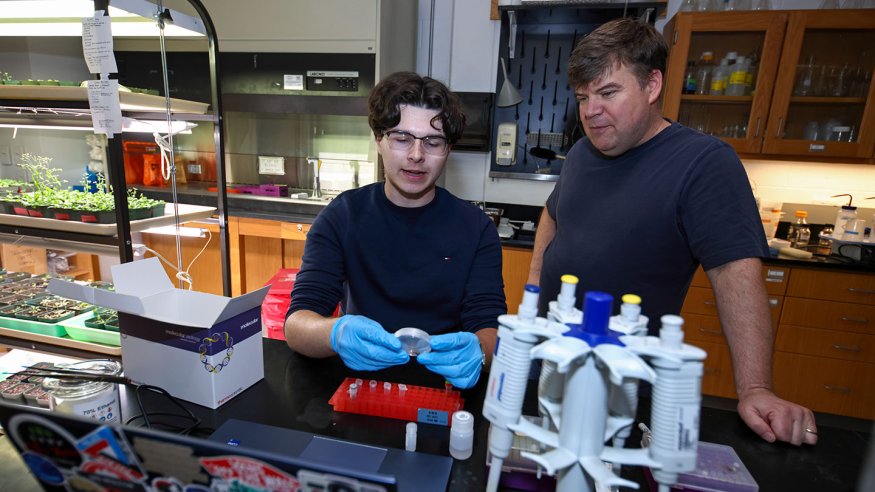
Growing Knowledge
Ohio Wesleyan Professor Chris Wolverton Co-Authors New Papers, Including International Space Station-Related Plant Research
DELAWARE, Ohio – Ohio Wesleyan University Professor Chris Wolverton's plant research continues to take root, with new findings published in the Proceedings of the National Academy of Sciences (PNAS) and in Plant Physiology.
Space Station Findings
The Plant Physiology article is the first paper resulting from Wolverton's NASA-supported work to send Arabidopsis thaliana seedlings to the International Space Station to explore how the plants, a member of the mustard family, grow under different gravitational conditions. The findings provide molecular evidence that plants use more than one mechanism to activate signals to keep their roots growing downward.
Wolverton, Ohio Wesleyan's Albert M. Austin Professor in Natural Sciences in its Department of Biological Sciences, says the research is important because it continues to explain how plants grow and the conditions – on or off Earth – in which they can thrive.
"Plants can tell which way is down by detecting the position of small organelles called statoliths inside certain cells, but even when these don't move, plants are still able to sense gravity," said Wolverton, Ph.D.
"In these experiments on the International Space Station, we found the minimum amount of simulated gravity that would activate the gravity response in these plants, and then we were able to link this level of gravity with an abrupt change in the expression of hundreds of genes," he said. "This kind of change in gene expression, which is the downstream effect of cellular signals, is evidence of gravity perception at this treatment, which was around 0.3 g, or approximately Martian gravity."
'Most Sensitive Analysis to Date'
Wolverton wrote the Plant Physiology article in collaboration with colleagues at Ohio University in Athens, including first author Emma Canaday, and with OWU graduate Nathan Scinto-Madonich, Class of 2016, who worked for two years as a post-graduate research assistant in Wolverton's laboratory.
Their article is accompanied by a feature highlight in the journal, which notes the research "represents the most sensitive analysis to date of gravity-sensing capabilities in plants," offering evidence for a statolith-independent gravity-sensing mechanism first hypothesized in 1989.
Unifying Understanding
Wolverton's second article, published in PNAS, "brings together many distinct components of gravity perception and response into a unified model of regulation," he said.
"Using a variety of mutants, fluorescent protein localization, and high-resolution control over stimulation angles, we showed that angle dependence is the unifying feature of the statolith-based gravity response," Wolverton said. "This kind of mechanistic model will allow researchers to use the gravity sensing and response pathway to develop root systems with architectures specialized for growing in specific environments." PNAS is the peer-reviewed journal of the U.S. National Academy of Sciences (NAS).
Wolverton wrote this article with collaborators, including Ohio Wesleyan alumnus Iftekhar Showpnil, Class of 2013, who now works as a bioinformatics analyst at Nationwide Children's Hospital in Columbus.
Showpnil worked with Wolverton on the research as part of OWU's annual 10-week Summer Scholarship and Research Program (SSRP) and attended an international conference to present a poster on their work. The conference has led to a long-term collaboration with Stefan Kepinski, Ph.D., and his laboratory at the University of Leeds in the United Kingdom, which collaborated on the PNAS article, Wolverton said.
A Space Star
Since joining the Ohio Wesleyan faculty in 2002, Wolverton's plant research has twice earned NASA research grants and resulted in appointments to the Space Studies Board (SSB) of the National Academies of Science, Engineering, and Medicine, as well as to the National Academies' panel on Biological Sciences in Space.
Because of his expertise, Wolverton also is helping Ohio Wesleyan explore collaborations with the Five Colleges of Ohio and The Ohio State University to develop a science park focused on space research, featuring a life-size replica of the Starlab space station.
Learn more about Wolverton, Ohio Wesleyan's Department of Biological Sciences, and the department's six majors and five minors at owu.edu/BiologicalSciences.
Founded in 1842, Ohio Wesleyan University is one of the nation's premier liberal arts universities. Located in Delaware, Ohio, the private university offers more than 70 undergraduate majors and competes in 24 NCAA Division III varsity sports. Through its signature experience, the OWU Connection, Ohio Wesleyan teaches students to understand issues from multiple academic perspectives, volunteer in service to others, build a diverse and global perspective, and translate classroom knowledge into real-world experience through internships, research, and other hands-on learning. Ohio Wesleyan is featured in the book "Colleges That Change Lives" and included on the U.S. News & World Report and Princeton Review "Best Colleges" lists. Connect with OWU expert interview sources at owu.edu/experts or learn more at owu.edu.