
'Monumental Moment'
Ohio Wesleyan Student Publishes in Professional Journal, Sees Career 'Coming to Fruition'
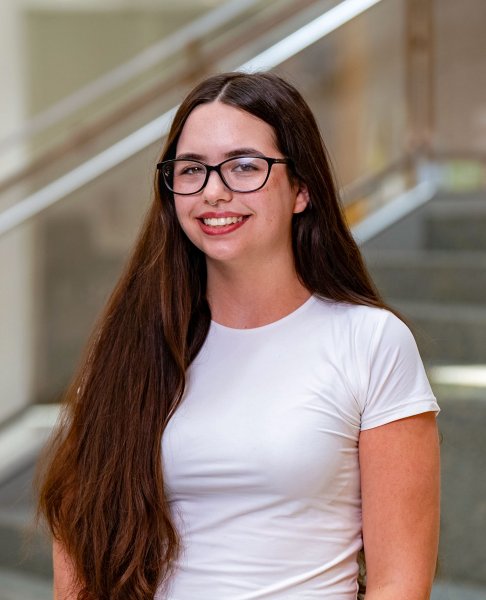
Brittney Parks '27 started her research career during her first semester at Ohio Wesleyan University – and she hasn't slowed down since. Fast-forward two years to fall 2025, and Parks is the lead author of a new paper published in the peer-reviewed Journal of Experimental Biology.
The paper, "The effects of meal size and feeding frequency on digestion in common wall lizards (Podarcis muralis)," appears in the August edition of the professional journal, along with an illuminating feature article that puts Parks in the "ECR (Early Career Researcher) Spotlight."
'Eye-Opening' Experiences
"My first eye-opening moment was the first time I worked on analyzing the data we collected," says Parks, a Zoology and Botany double major from Solvay, New York. "It was really interesting seeing the data we collected become meaningful and biologically significant conclusions.
"I would say my biggest eye-opening moment was after my paper was published," she continues. "It was very surreal for me to see that I was a published author and that my dream as a researcher was coming to fruition before my eyes. It was just such a monumental moment for my career."
Food for Thought
The research examines different feeding routines among common wall lizards, which were brought to Ohio from Italy in the early 1950s. According to her research abstract: "The results of this study highlight the importance of quantifying feeding regimes and natural temperature cycles, with implications for invasion biology and predicting responses to climate change."
Parks worked on the project with Ashley Mollett '27, a Zoology major from Westerville, Ohio; Eric Gangloff, Ph.D., associate professor of Biological Sciences; and Allison Litmer, post-doctoral researcher. The research was supported by a grant from the National Science Foundation.
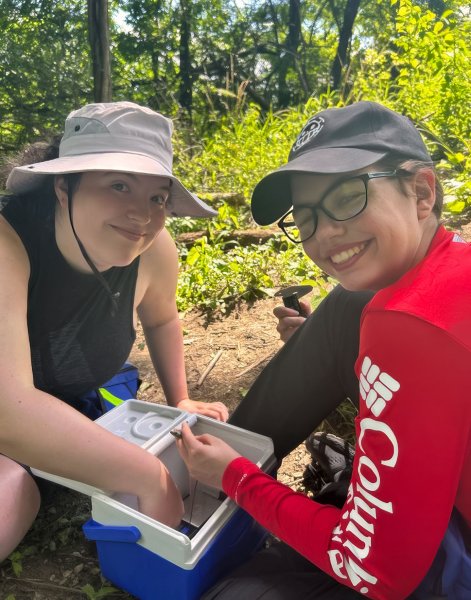
National Meeting
In advance of the journal publication, Parks presented her findings on campus and in a poster presentation at the 2025 annual meeting of the Society for Integrative and Comparative Biology, held in January in Atlanta, Georgia.
She will be presenting new research Sept. 18 at Ohio Wesleyan's 2025 Summer Scholarship and Research Symposium that expands her journal-published work, as well as continuing to work in the Gangloff Lab of Amphibian and Reptile Ecophysiology (GLARE) this academic year.
"This year, I am straying away from my previous research a bit," Parks says. "I am planning to focus on a project where I characterize and quantify the muscle differences between original and regenerated lizard tails."
Wildlife-Focused Zoology
She says she chose to attend Ohio Wesleyan, in large part, because of the university's Zoology majors, which include both Bachelor of Arts and Bachelor of Science offerings.
"The OWU Zoology program is more wildlife-focused, while many of the other schools I looked at were much more agriculture-focused," Parks says. "The financial aid I received from OWU also made it very accessible for me."
Read Parks' full research paper and ECR Spotlight in the Journal of Experimental Biology. Learn more about Ohio Wesleyan's Zoology majors at owu.edu/BiologicalSciences and more about enrolling at Ohio Wesleyan, including financial aid information, at owu.edu/admission.