
Alaskan Expedition
Ohio Wesleyan Students Explore 'Plant Responses to Global Change' During Travel-Learning Course
Name: Alex Bzdafka '27
Hometown: Solon, Ohio
High School: Solon High School
Majors: Biology and Environmental Science
Minor: Chemistry
Name: Camille Mattox '27
Hometown: Blacklick, Ohio
High School: Licking Heights High School
Majors: Environmental Science and Sociology & Anthropology
Minor: Biology
OWU Connection Experience: "Plant Responses to Global Change" (Biology 355), a Travel-Learning Course featuring a semester-long class followed by a May 12-22 trip to Alaska to explore firsthand the issues and ideas studied
In her syllabus for the Travel-Learning Course (TLC), Professor Laurel "Laurie" Anderson shares: "The course is organized around four major global environmental changes: increases in atmospheric CO₂, increases in temperature, increases in nitrogen deposition, and changes in precipitation patterns. We will explore how plants and ecosystems interact with these changes and the implications of these interactions for plant growth and survival, global biogeochemical cycles, and the future of the biosphere. ... The boreal/tundra region of Alaska, which has experienced the most dramatic warming of any location on the globe, will be used as a case study to explore these topics more deeply." (Anderson is the Morris Family Professor of Natural Sciences and the Shanklin Family Professor in the Department of Biological Sciences.)
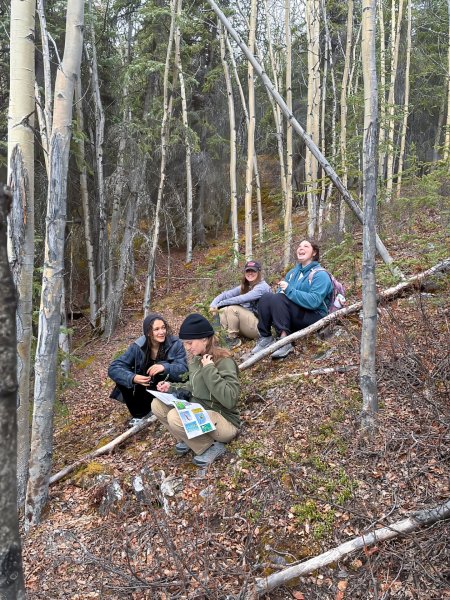
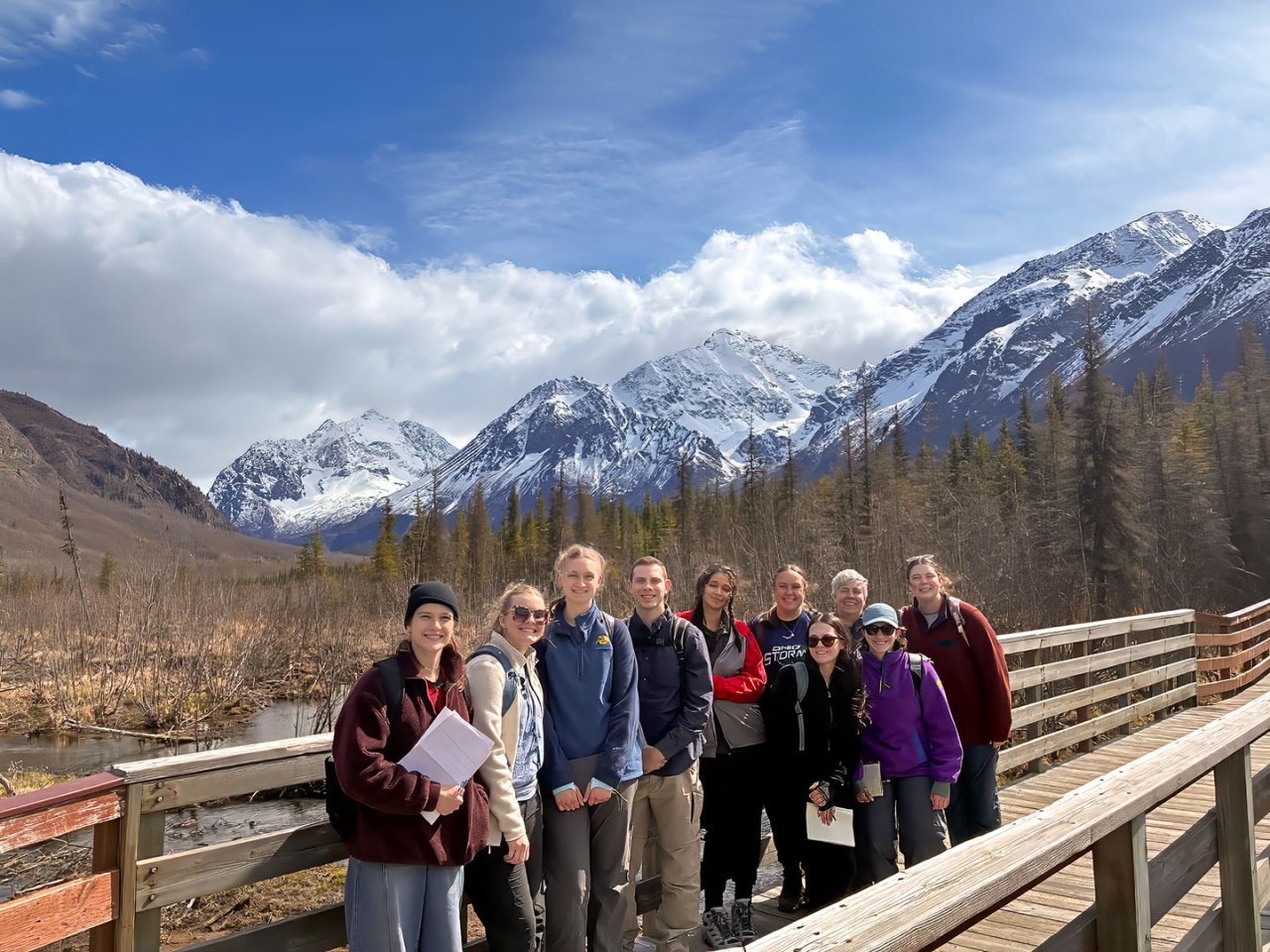
Along with Bzdafka and Mattox, Ohio Wesleyan students traveling to Alaska were Isabel Allo '26 of Ridgefield, Connecticut; Ariana Brown '26 of New York, New York; Claire Hammond '26 of Cincinnati, Ohio; Elizabeth Radloff '29 of Milford, Ohio; Pacey Schtucka '26 of Wadsworth, Ohio; Sky Thompson '26 of Delaware, Ohio; and Megan Tooill '27 of Lancaster, Ohio.
Why This Opportunity?
Bzdafka: "As a Biology and Environmental Science major, I am concerned about a number of environmental issues, the largest of which is climate change. Taking a course centered on this topic was important to me because I wanted a better picture on how it is affecting the world. As a person focused on plants for research, having that class centered around plants made it even better.
"The travel aspect of this course elevated my learning experience, as I was able to see things that I had only read about for the class. It is one thing to read about a glacier and how it carves out the land, how it exposes bare soil and removes plants when it melts. It is a very different thing to see that in person and to witness ecological succession firsthand."
Mattox: "This was my first travel experience with Ohio Wesleyan, and I think it is one of the highlights of OWU's academics. I was especially excited to be traveling for a course so closely related to my major, so I knew I had to take full advantage of it. I also had some experience working with Dr. Anderson in the past and was thrilled by the opportunity to see how her teaching style – which emphasizes careful observation and artistic connection – would differ from the classroom, to the field, to outside of the state, in an entirely new environment!"
Affirmation and 'Aha' Moments
Bzdafka: "We also met with a number of biologists and experts who are working with plants in the area, and they affirmed many of the things we learned in class. There was a running joke during the trip that Dr. Anderson was not lying to us when she said something in lecture. This is because there is a lot of skepticism around climate change, and as students, we sometimes feel a disconnect between the real world and the classroom.
"[We benefitted from] being able to hear from people currently working on what we studied during the course, and they confirmed that what we learned is actually happening. They also spoke to us about concepts we learned throughout the course, which made the content really stick with us and helped bridge that gap from the classroom to the world outside. During the trip, I think that we all had that 'aha' moment because of this."
Favorite Moments
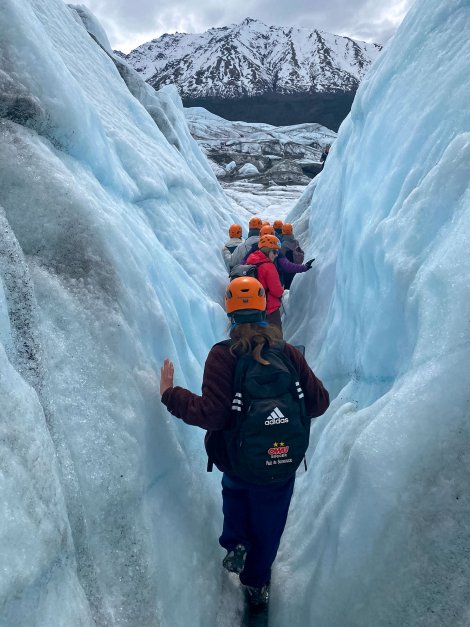
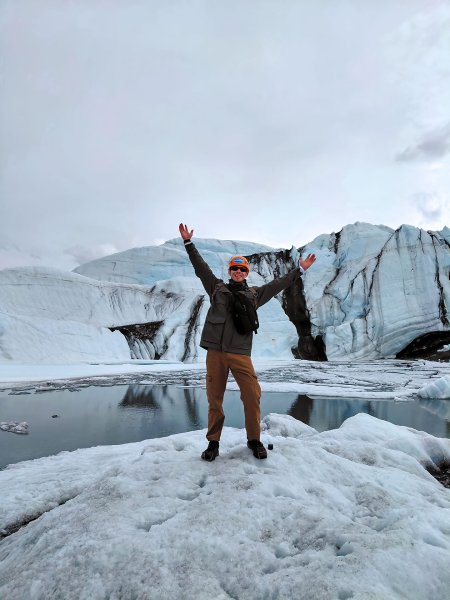
Bzdafka: "My favorite experience was our glacier hike. This is because during the course we had to write a special topics paper about Alaska or the boreal region of the world. This exercise helped us gain some understanding of the area, as well as develop a greater understanding of the lecture material. My paper was on how plants colonize the bare soils exposed when glaciers melt, so being able to actually go to a glacier and see that firsthand was enlightening. There were a number of plant species I read about as being the 'pioneer species' that first colonize the area, and as we were walking around, I could, in fact, see those species present. It also helped put into perspective just how powerful a glacier is, as we could see where it had carved mountains and shaped the surrounding landscape."
Mattox: "I love to hear what my peers notice on hikes. We hiked through glaciers, forests, rocky terrains, and shrubby boardwalks, each offering a variety of vegetation, wildlife, and geophysical characteristics. Each person brought a different set of knowledge to the group, and getting to experience a little bit of everyone's expertise allowed for exciting group discussions and well-rounded, personally experienced knowledge. I'm especially partial to our glacier hike because of how interactive it was. Most of our group had never been on a glacier before, so everyone was experiencing something new while relating it to something familiar to them personally. We also got to swim in the glacier's melt pool!"
Lessons Learned
Bzdafka: "One of the coolest things I learned was that similar to plants in the Amazon, spruce trees in the boreal forest can also produce clouds. However, unlike trees in the Amazon, which act like pumps channeling water from the soil to the atmosphere, spruce trees can collectively release terpenes into the air, which act as nuclei to form clouds.
"During the course, we discussed macrosystems ecology, which is an area of study that focuses on how organisms and the environment can interact with one another at different scales. The spruce trees, I felt, directly relates back to that (macrosystems) since a population of trees, which is a rather small scale, can produce clouds that could affect a nearby city, or perhaps the entire state.
"I think this experience was beneficial to my classmates and me because, for one, it was incredibly fun. We spent a lot of time outside in the last frontier, which was teeming with more nature than I had seen in my whole life. Additionally, we had a fantastic group. We meshed really well, and collectively we were able to feed off of one another's energy, which made it so much more fun."
Mattox: "Our parent course, 'Plant Responses to Global Change,' stressed the complexity of climate change. Many of the tour guides and experts that we had the pleasure of speaking with confirmed this complexity. One example was shared by a guide on our Denali research tour. Spruce bark beetle behavior is believed to be dependent on temperature, and after a record-freezing year, the beetles did not act as expected. This could be due to other factors, adding complexity to plant and animal interactions, such as increased lightning and increasing wildfire intensity and duration. These findings directly supported our classroom material, making the concept a reality.
"In addition, visiting the Native American Heritage Center gave me information and interest to carry into a summer research experience that I will be participating in following the Alaska TLC. The AquEOUS program at the University of Maine implements a method called two-eyed-seeing that includes Indigenous and Western sciences, so I was thrilled to learn about how Alaska Indigenous groups interacted with their environment in ways that grew their knowledge through careful observation. With my double major in Environmental Science and Sociology & Anthropology, I greatly value different cultural approaches to human interactions with the environment."
Travel-Learning Courses help you connect with the content of a class, similarly to a lab, but elevated.
An Elevated Experience
Bzdafka: Travel-Learning Courses help you connect with the content of a class, similarly to a lab, but elevated. Something that makes this kind of experience different from a lab is the informal setting of it. I would often see something when we were in the car or in the field that sparked a question, and I was able to, without raising my hand, ask that question, which then sometimes prompted a longer discussion."
Mentoring Professors
Bzdafka: "Dr. Anderson was the lead faculty member on this trip; she taught the class we took and planned the trip to connect back to the course as much as possible. She also helped us make connections back to our coursework.
"Dr. Rowley was a great addition to the trip, as there was a lot of geology and geography to discuss on this trip. Mountains were ever-present and having his expertise helped us understand how those mountains were formed, what they were made of, how glaciers were interacting with them, and how all of this tied back to plants."
(Laurie Anderson, Ph.D., is a professor of Biological Sciences and plant ecologist; Nathan Rowley, Ph.D., is an associate professor of Environment & Sustainability and physical geographer whose interests include climatology and glaciology.)
Campus Involvements
Bzdafka: "I'm a pole vaulter on the men's track and field team, and I am a member of the Department of Environment & Sustainability's student board."
Mattox: "I am involved in many different forms of art on campus, and I believe its connection to science and the natural world is powerful. I am involved in the Ross Art Museum as a visitor experience intern and through their Art and Environment Talk Series class. Additionally, this will be my second year in the Creative Arts House (CAH), where I can share my own perspective on the place of creativity in the sciences." (The Creative Arts House is one of OWU's small-living units, which offer themed housing options.)
Why Ohio Wesleyan?
Bzdafka: "I initially started looking at OWU because of track; however, Dr. Anderson was actually the reason I chose to come here. She helped me get a better sense of the Biological Sciences Department and what it could offer me, as well as how the OWU Connection tied into that. OWU offers a lot of opportunities for students to do real work here, from independent studies, SSRP (Summer Scholarship and Research Program), Travel-Learning Courses, study abroad, OWU Connection grants (including Theory-to-Practice Grants), and because of Dr. Anderson and her mentorship, I have taken advantage of almost all of those."
Mattox: "I knew I wanted to go to a small college, and I valued the emphasis that liberal arts colleges put on well-rounded education. I came into college knowing I wanted to learn more about earth sciences and the state of the environment. Ohio Wesleyan had lots of opportunities for real-life experiences and connections through various STEM programs, so I knew I would have a good start and some flexibility here."
Plans After Graduation
Bzdafka: "I plan to pursue graduate school in plant ecology. I initially came to OWU planning to focus my coursework in zoology; however, I quickly realized that zoology was not for me. Luckily, there are a number of botany courses offered here, so I was able to pivot my plans easily. I have taken, so far, all but one botany class. I have and continue to conduct research on plant ecology. This research has helped me stand out enough to have earned a National Science Foundation Research Experience for Undergraduates last summer, SSRP this summer, and then, hopefully, a graduate program once I graduate. Grad programs are looking for students who can do more than study, and thankfully, OWU has helped me get experience, which is becoming more and more coveted in today's world. I do not think it is just the amount of research I have done that will make me stand out, but it is what I gained from it.
"I have come to anticipate roadblocks, learned to troubleshoot issues that tend to occur when doing research, and accept likely one of the hardest lessons to learn: that no one truly knows what they are doing. While most people have an understanding that we do not know everything, know this more than anyone. In a field where our job is to learn and discover new things, it is literally impossible to know everything. I think that having already learned and accepted this fact has provided me with confidence that I am allowed to fail, as long as I can learn and grow from that failure."
Mattox: "I plan to jump straight into the workforce after completing my bachelor's degree. I want to get practical experience and test my ability to adapt to a variety of positions, and I have started this journey through the TLC to Alaska, independent studies, internships, and TPGs through OWU. For the TLC specifically, it allowed our group to hear from a variety of methods of reaching and participate in ecological monitoring."