
Universal Understanding
Ohio Wesleyan Student Contributes to Gravitational Wave Research for Future Space Mission
Name: Anushka Sharad '27
Hometown: Pune, Maharashtra, India
High School: Priyadarshani High School
Majors: Astrophysics and Mathematics
Minor: Philosophy
OWU Connection Experience: Attending the Global Physics Summit organized by the American Physical Society (APS) and subsequently conducting research with Shane Larson, Ph.D., director of Integrated Engineering & Applied Science Projects at Clarkson University in Potsdam, New York.
A Significant Summit
"I went to several talks on gravitational waves, and one of them was by Dr. Shane Larson, with whom I later had the chance to do research. After his talk at the conference, I walked up to him, told him how much I wanted to do research in this field, and mentioned that I was looking for resources. I asked if he could connect me with some.
"What ended up happening was even better, he offered me the opportunity to work under him, and I was able to do research with him throughout the summer. That work is still ongoing. This experience was, in every sense, a true example of 'making a connection,' because it all happened as a direct result of attending that one talk at the conference."
A New Way of Observing the Universe
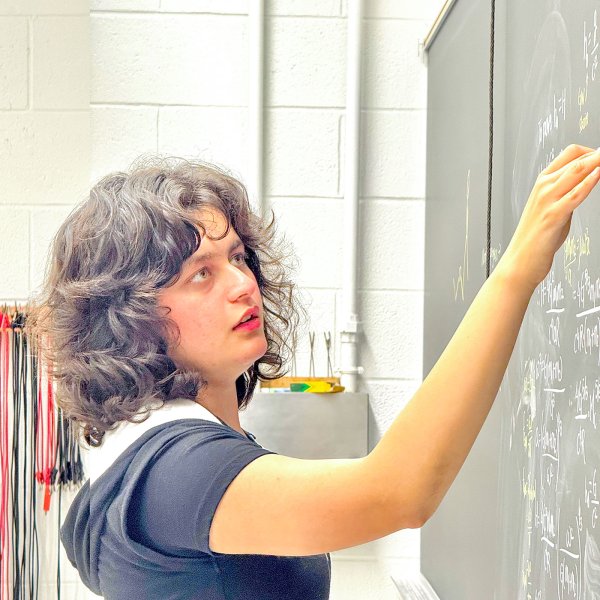
"In collaboration with Dr. Shane Larson, my research focuses on simulating gravitational waveforms from Extreme Mass Ratio Inspirals (EMRIs), where a compact stellar-mass object orbits a supermassive black hole. Gravitational waves provide a completely new way of observing the universe, carrying information about regions of strong gravity that cannot be probed with light. By studying them, we gain insights into the nature of spacetime, the demographics of black holes, stellar evolution, and the dynamics of galaxies.
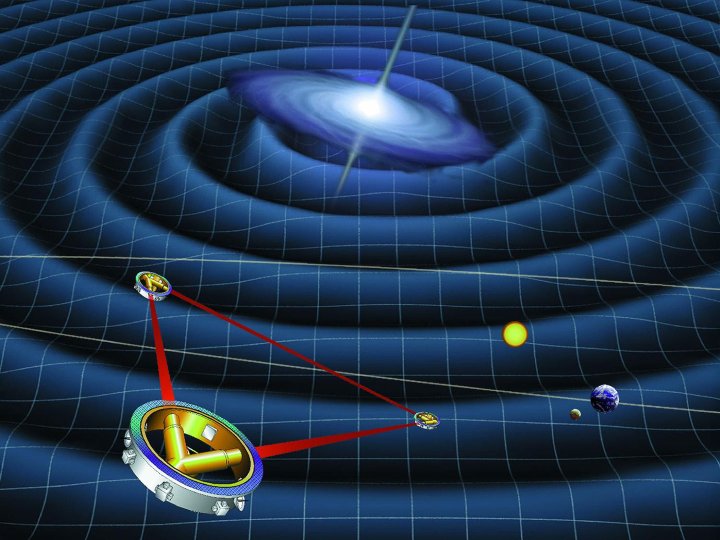
"EMRIs are prime sources for the Laser Interferometer Space Antenna (LISA), a space-based gravitational wave observatory scheduled for launch in the 2030s. Detecting and accurately modeling these signals is crucial, as they will allow us to test general relativity in the strong-field regime, map the spacetimes of supermassive black holes, and uncover populations of compact objects that are otherwise invisible."
My OWU Mentor
"Dr. Robert Harmon is my on-campus advisor. He helps me understand key ideas more clearly, and his questions push me to strengthen my understanding. He checks in with me regularly, and it is always a pleasure to have him as someone to talk to."
Why This Experience?
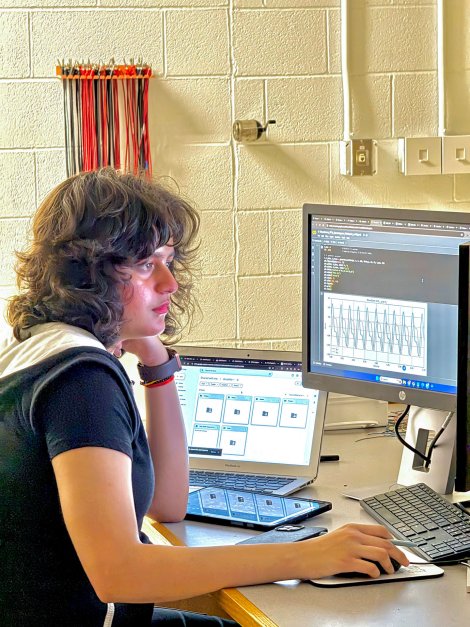
"I have long been fascinated by the fundamental nature of the universe, and gravitational waves represent a frontier where physics, mathematics, and computation meet. Working with Dr. Larson allowed me to move beyond textbooks and engage in the research process, solving Kepler's Equation, generating waveforms, and analyzing signals that anticipate what LISA will one day detect.
"I also wanted to strengthen the skills that make theoretical ideas tangible. Coding simulations, testing algorithms such as solving equations numerically and applying Fourier analysis, and interpreting the physics behind the results showed me how abstract equations translate into concrete insights about the cosmos."
"[S]ifting through a vast body of ideas until something resonated deeply, felt like experiencing a calling. It showed me not just what I could study, but why certain questions matter to me more than others.
My Favorite Moment
"My favorite moment was the process of finding my own research direction. Since the project was remote, I spent much of my time reading, exploring the field broadly, and then narrowing down the specific problem I wanted to work on. Identifying a research topic in this way, sifting through a vast body of ideas until something resonated deeply, felt like experiencing a calling. It showed me not just what I could study, but why certain questions matter to me more than others.
"Along the way, I had to teach myself many things: new concepts in physics and mathematics, programming techniques, and methods for solving equations. Discovering resources, working through books, and piecing together understanding independently was both challenging and rewarding. I often felt like I was at sea, charting my own course, with my professor serving as a lighthouse who guided me while still allowing me to navigate on my own. That balance of independence and support, and the sense of self-driven discovery it created, was the most meaningful part of the experience."
Lessons Learned
"One of the main lessons I learned was how directly my classroom learning connects to real research. The advanced astronomy and cosmology courses I have taken provided the foundation I needed. With that in place, I could build upward, applying concepts to questions at the frontier of gravitational wave physics.
"Another lesson came from realizing how my work ties into the future of the field. The research I did was based on simulating and modeling the signals that the LISA mission will observe in the 2030s. What we are working on theoretically today will one day be compared with real data, helping the scientific community interpret the discoveries that LISA will deliver. Contributing, even in a small way, to the groundwork for such a major mission gives us a sense of responsibility and excitement, and it strengthens our commitment to continue pursuing opportunities to work with LISA data in the future.
'The Science of Tomorrow'
"Experiences like this matter because they bring everything together. Textbook knowledge from class, topics I explored on my own, tools and techniques I had to teach myself, all of it came together in service of a larger mission. I am preparing to join a community that will use these methods in the coming decade. That sense of connection between my learning today and the science of tomorrow is the most valuable lesson I carry forward."
Campus Involvements
"This year, I am serving as the president of the Society of Physics Students (SPS) and the secretary of the Astronomy Club, making sure I contribute to the community as a whole while creating spaces where we can learn and grow together. I am also active in philosophy courses and take part in activities that allow me to present and share the work I do.
"Beyond academics, I serve as a Resident Assistant and work in the library. Both roles reflect how much I value being part of a community centered on knowledge. I truly love everything about learning and sharing it with others."
Why Ohio Wesleyan?
"Perkins Observatory was a major draw, as it gave me the chance to connect directly with astronomy beyond the classroom. The small campus size and the strong support for international students made it feel like a place where I could belong and thrive. Most importantly, the Physics and Astronomy Department and its professors were a deciding factor. Throughout my life at Ohio Wesleyan, the professors have been the best part, offering both guidance and inspiration."
My Plans After Graduation
"After graduation, I want to continue pursuing research in astrophysics while also helping other students gain access to the kinds of resources and opportunities that shaped my own path. I hope to share science widely, especially astronomy, by talking with students, exchanging ideas, and passing on knowledge and experience. My goal is to remain a student of the field, contributing through research while also building a community around curiosity and discovery.
"My time at Ohio Wesleyan has prepared me for this in many ways. I am developing a strong foundation in physics and mathematics, while also learning to draw meaningful connections with philosophy. These parallels across disciplines are shaping the way I think about science and its place in the human story, and I hope to carry that forward in both my research and the way I engage with others."