
Teaching Moment
Seeing the Frame
On a chilly fall morning, a group of high school students stepped onto the campus of Ohio Wesleyan University with a mix of curiosity and nerves. They were participants in I Know I Can (IKIC), a nationally recognized nonprofit that empowers Columbus students to explore and pursue college and career opportunities through individualized advising, innovative programs, scholarships, and grants.
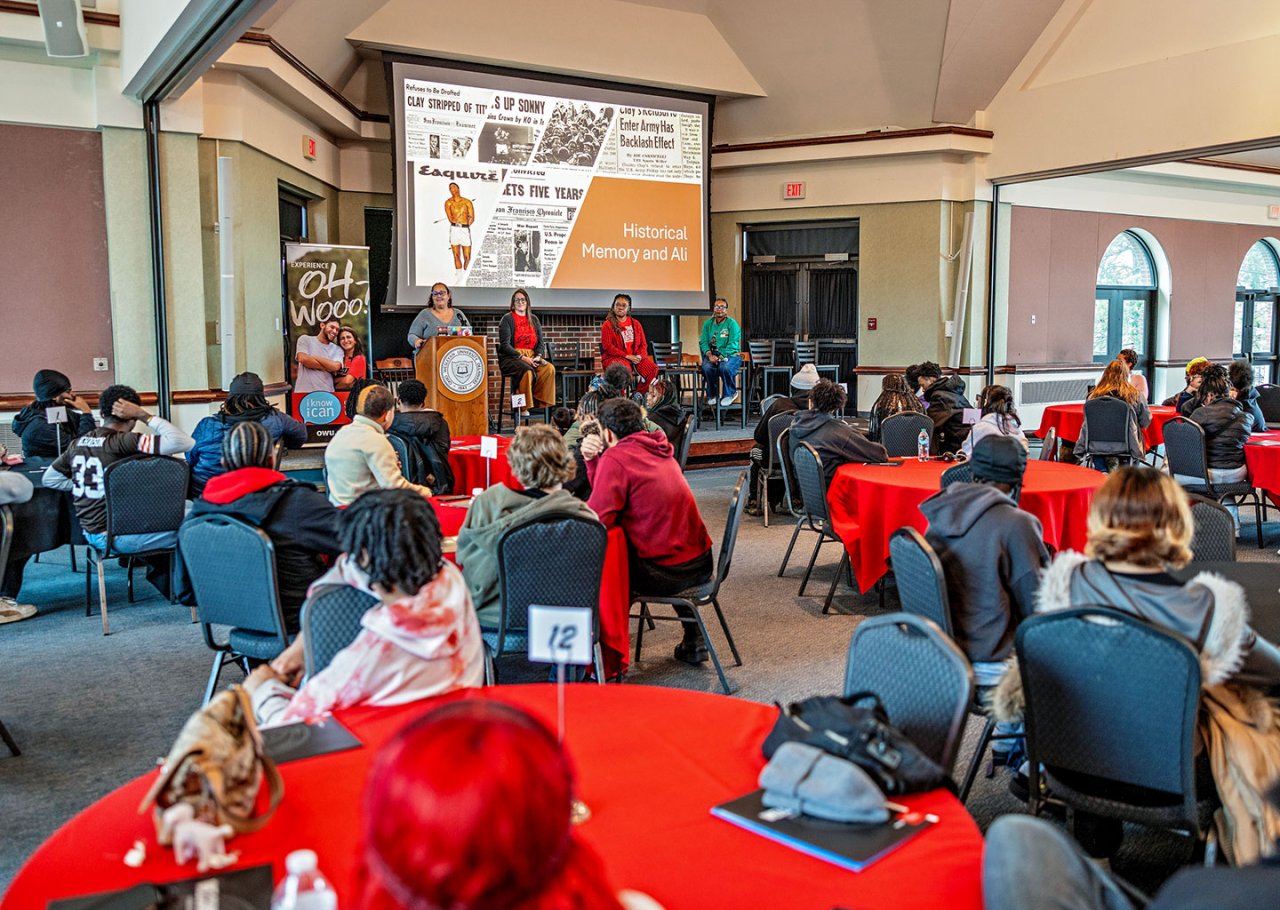
The architect of the day, Director of Access and Strategic Recruitment Tenique Dennis, had a clear goal: create a space where students could explore, connect, and discover what OWU campus life truly feels like. Instead of a typical visit, she and the Admission team built something more immersive—a mini-class led by four faculty members whose work bridges disciplines and lived experiences.
Inside a classroom, the energy shifted from campus visit to intellectual exchange. Dawn Chisebe, Phokeng Dailey, Ashley Kennard, and Brianna Mack stood at the front— not as lecturers taking turns, but as collaborators modeling what coteaching can look like at its best.
Their subject: how we see the world—and how the world is shown to us.
To bring the concept to life, they turned to a familiar figure: Muhammad Ali. Students examined newspaper headlines, radio clips, and media portrayals of Ali across different moments in his career. Some depictions celebrated him as a hero and champion. Others cast him as controversial, even divisive.
"What changed?" one student asked.
"Not always Ali," a professor replied. "Often, it was the frame."
The lesson centered on the idea of framing—a concept from media and communication studies that explains how information is presented. A frame highlights certain aspects of a story while downplaying or ignoring others. It acts as a mental shortcut, shaping how audiences interpret people, events, and ideas. The media, the class discussed, doesn't just report reality— it helps construct it.
As the conversation deepened, students began applying the concept beyond Ali. How are communities portrayed in the news? How do social media platforms shape perception? What stories are amplified—and which are left out?
The room grew more animated. This was no longer about a legendary boxer from decades past; it was about understanding the forces that shape their own perspectives.
The session also offered a glimpse into OWU's Summer Bridge Program, a free, three-week residential experience that many of the instructors help lead. The program offers incoming students the chance to earn academic credit while building critical thinking skills and forming a supportive community before their first semester begins. Rooted in leadership and inclusion, Summer Bridge invites students from all backgrounds—while holding particular value for those who identify as first-generation, LGBTQIA+, neurodiverse, or from other historically underrepresented groups.
Yet, as faculty explained, its impact extends across identities. Students often leave with a stronger ability to engage in meaningful dialogue, a deeper understanding of perspectives different from their own, and a willingness to challenge assumptions—to tear down walls and build bridges.
By the end of the mini-class, the IKIC students weren't just visitors anymore. They were participants in the kind of learning that defines the OWU experience: collaborative, reflective, and grounded in real-world relevance.
And perhaps most importantly, they left with a new question in mind—one that will follow them into classrooms, conversations, and communities:
Who chose the frame—and what might I be missing?
The Dr. Charles Thomas Scholarship, which supports students from Columbus City Schools, Reynoldsburg City Schools, South-Western City Schools, and Whitehall City Schools, has cemented the partnership between OWU and IKIC. Each year, up to 25 high school seniors receive financial aid covering at least full tuition for four years—an investment designed to remove financial barriers and open doors to higher education.