
'Impact Immediately'
Ohio Wesleyan Students Earn Business Development Funds During Annual Pitch Competitions
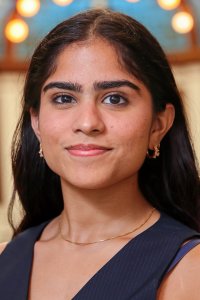
DELAWARE, Ohio – Ohio Wesleyan University senior Aryaka Tickoo is developing a standardized tool to help Delaware County and other communities quickly assess whether their infrastructure will support large-scale data center operations.
"The question is, how shall we live … intentionally or reactively?" Tickoo told judges when she presented her concept during OWU's 2026 Big Problem Challenge. Tickoo, an Environmental Science and Business Administration (Management) double-major from Mumbai, India, won the Feb. 26 entrepreneurship competition for her Delaware County Data Center Model. She earned a $3,000 prize to help her continue developing her idea.
Digging Into the Data
This year's Big Problem Challenge asked students to explore: "How might we accommodate continued population growth in Delaware County in a way that supports the quality of life for residents and the preservation of natural resources that we cherish?"
Tickoo chose to focus on large-scale data centers, creating what she describes as "a three-sector partnership model reducing data center water and electricity demand through coordinated action." Those sectors are:
- Government Framework, incorporating a special data center oversight committee, legally binding community benefit agreements (CBAs), and pre-approval cost-benefit analyses that factor in environment, health, economics, and equity.
- Private Sector Innovation, such as Central Ohio-based Vertiv's zero-water cooling technology and solar energy companies generating additional renewable power.
- Resident Participation, highlighted by a "digital twin" tool that enables anyone to quickly model "what if?" scenarios using a gaming interface and a public dashboard for transparent accountability.
"The main focus," said Tickoo, noting that Central Ohio already has more than 130 data centers, "is to make an impact immediately." Her goal is to help both communities and companies reach good solutions, noting that clarity of these development issues "does not repel investment; it earns it."
A Pitch and a Score
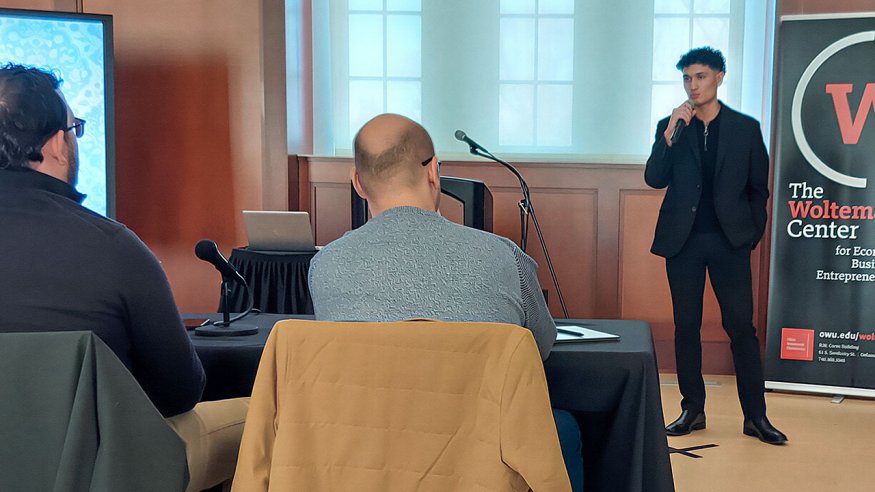
In addition to the Big Problem Challenge, Ohio Wesleyan also hosted its annual Pitch OWU competition on Feb. 26, with both events organized by The Woltemade Center for Economics, Business and Entrepreneurship.
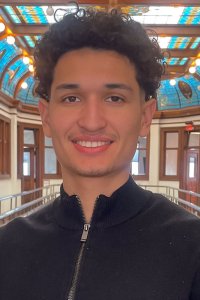
Sophomore Luis Cañas Jr. took the top prize in this "Shark Tank"-style competition for his app, "eunri – The Training Operating System for Modern Youth Soccer."
Cañas, a Business Administration (Marketing) major from Wooster, Ohio, created the app to help motivated soccer players ages 12-18 practice effectively on their own and then to enable their coaches and clubs to monitor their progress.
"For driven youth soccer players, the biggest improvements rarely happen during weekly team practices," Cañas contends, "they happen in the hours spent training independently."
Players using eunri answer four questions – how long they plan to train, in what kind of space, with a focus on which skill, and with access to what equipment. In response, the youths get a complete, structured session in under 30 seconds that includes warm-up, drills, and cool-down. The app is free for players to use, with coaches and clubs charged fees to access their players' information.
More Big Problem Solutions
In addition to Tickoo, other competitors selected to participate in the Woltemade Big Problem Challenge, their ideas, and their awards included:
- $1,500 recipient: Sophomore Jera Hoy, an Accounting major from Radnor, Ohio, for GradHaus™, a real estate development and management company of tiny house communities that would provide graduate students and young professionals with "an affordable opportunity to live independently, be part of a community, and build equity without a down payment." Residents would set aside a percentage of their rent to invest in a money market fund, building "equity" to put toward their next home. The tiny home leases would run for no more than six years, the average time people live in their starter home.
- $750 recipients: Sophomore William "Hank" Johnson, an Accounting major from Barnesville, Ohio, and first-year students Darren Krider, a Finance major from North Olmsted, Ohio; Joey Christy, a Finance major from Pickerington, Ohio; and Abe Parillo, an Accounting and Finance double major from Ashland, Ohio. The four Bishops proposed Solar Solutions, a company that would work to "power Delaware County forward by cutting electricity costs." Their proposal would seek to speed up and simplify zoning approvals for residential solar panels while allowing homeowners to adopt the renewable energy technology without restrictive upfront costs. Ultimately, they want to eliminate residential electric bills.
- Gift card recipient: Senior Joshua Adjei, a Politics & Government major from Thurmont, Maryland, for SecureVision Managed Services. The budget-friendly security system provider would monitor common areas, incorporating solar energy and dramatically reducing costs for Homeowners Associations (HOAs) with expensive security-monitoring contracts. The saved funds could be redirected toward other essential services, Adjei says, who has tested his system in a Maryland neighborhood.
More Pitch OWU Proposals
In addition to Cañas and his eunri soccer-training app, other competitors selected to participate in the 2026 Pitch OWU competition, their ideas, and their awards included:
- $1,500 recipients: Senior Aninditha Nair, a Computer Science and Data Analytics double-major from Dombivli, India, for Dhaaga. ("Thread" in Hindi.) "Over 92 million tons of textiles are discarded globally each year," Nair states, "yet less than 1% are recycled back into new fibers." One of the biggest bottlenecks is manual sorting. Dhaaga is "a modular, conveyor-mounted hardware unit that uses computer vision and artificial intelligence to automatically classify garments in real time." It is trained on real-world textile data to identify fabric type, detect defects, and more in seconds. "By improving accuracy and throughput, Dhaaga increases resale value, improves recycling stream purity, and makes circular textile processing economically viable," Nair states.
- $750 recipients: Sophomore Husain Qazilbash, a Business Administration (Marketing) major from Lahore, Pakistan; first-year student Bilal Ahmad, an Accounting and Finance double-major from Lahore, Pakistan; and senior Dua Asim, a Quantitative Economics major from Karachi, Pakistan. They proposed Karigar International, a company that works with Pakistani artisans to source luxury-grade, handcrafted, and foldable tables appropriate for small spaces. ("Karigar" means artisan.) The students have completed their supplier validation and are working to build relationships with boutique stores in Central Ohio to sell the unique tables designed for on-the-floor seating.
- Gift card recipients: Seniors Wasif Karim, a Computer Science and Astrophysics double-major from Dhaka, Bangladesh, and Tasfia Rahman, an International Business major, also from Dhaka, for OnlySwap, a "campus-focused, AI-powered sustainability-driven exchange platform" that seeks to save students money, help them avoid online scammers, and reduce the waste stream by finding new homes for dorm room staples, such as mini-refrigerators and futons, when their owners no longer need them. "The swipe-based interface combines anonymous listings with verified identities, making exchanges fast, intuitive, and secure," they state.
Both competitions were moderated by Cliff Hurst, assistant professor of Economics & Business and faculty liaison to the Delaware Entrepreneurial Center at Ohio Wesleyan University (DEC OWU). A first-of-its-kind liberal arts business accelerator, the DEC OWU is a collaboration with the City of Delaware and Delaware County.
The pitch competitions were judged by Nic Langford, economic development director for the City of Delaware; Fabio Zomer Volpato, co-founder of the U.K.-based Corryn Biotechnologies Ltd.; and Nick Potts, serial entrepreneur, entrepreneurship instructor, and founder-in-residence at the DEC OWU. The prizes were funded by Latham Bishop Ventures, an endowed program funded by 1961 OWU alumna and entrepreneur Carol Latham.
Learn more about The Woltemade Center at owu.edu/Woltemade and the Delaware Entrepreneurial Center at OWU at owu.edu/DEC.
Founded in 1842, Ohio Wesleyan University is one of the nation's premier liberal arts universities. Located in Delaware, Ohio, the private university offers more than 70 undergraduate majors and competes in 24 NCAA Division III varsity sports. Through its signature experience, the OWU Connection, Ohio Wesleyan teaches students to understand issues from multiple academic perspectives, volunteer in service to others, build a diverse and global perspective, and translate classroom knowledge into real-world experience through internships, research, and other hands-on learning. Ohio Wesleyan is featured in the book "Colleges That Change Lives" and included on the U.S. News & World Report and Princeton Review "Best Colleges" lists. Connect with OWU expert interview sources at owu.edu/experts or learn more at owu.edu.